-
E-mail
czsmdryer@163.com
-
Phone
18861236698
-
Address
Zhenglu Industrial Park, Changzhou City, Jiangsu Province
Jiangsu Shengman Technology Engineering Co., Ltd
High tech in the black box - spray drying energy recovery
Date: 2025-08-04Read: 4
High tech in the black box - spray drying energy recovery
In traditional spray drying (open type), in order to reduce the final water content of materials, the exhaust temperature is often as high as 90 ℃ or higher.
Flash evaporation drying and fluidized bed boiling drying are processes that use gas to directly contact materials to achieve drying effects, and the exhaust temperature can also reach around 50-80 ℃.
The temperature in the exhaust gas means energy, and if measures are not taken to allow the exhaust gas to be discharged, it means a waste of energy. The higher the exhaust temperature, the more energy is wasted.
Energy consumption is directly linked to production costs, and whoever incurs costs wins the world.

How to utilize the energy of exhaust gas? We need to utilize the heat recovery system
Heat Recovery System。 The most common type is a heat exchanger that prevents direct contact between exhaust gas and intake air. Through a plate heat exchanger, the heat from exhaust gas is transferred to the intake air, reducing the use of steam or electricity during intake air heating.

The Tecpharm coating machine under Romaco Group in Germany is equipped with a plate heat exchange exhaust gas energy recovery system and can also be equipped with a heat pump energy recovery system
Plate heat exchangers cannot extract heat energy from exhaust gas to a large extent, and their recovery efficiency is limited. So, companies specializing in thermal energy recovery equipment emerged in the market, which extract the maximum amount of thermal energy from exhaust gas through isentropic conversion.
The equal enthalpy value, isoenthalpy conversion, and the black box system that does not disclose the internal structure of the equipment make this set of equipment feel mysterious.
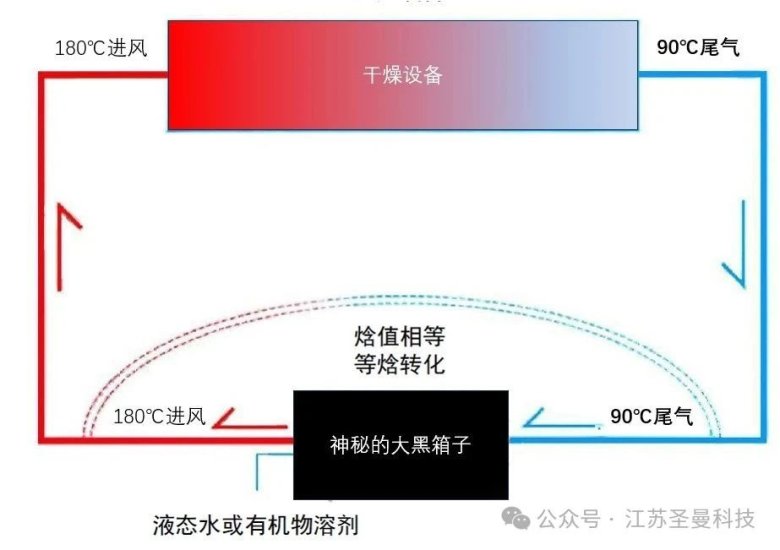
A black box that heats up the process air on its own without the need for additional heating
So what exactly is inside the black box? It's not that mysterious, actually it's an industrial heat pump inside!
The working principle of industrial heat pumps is the same as that of household refrigerators, transferring heat from low-temperature environments to high-temperature environments. Heat pump can recover heat energy from waste heat, such as high temperature tail gas of spray drying, flash drying and other equipment, and reuse it (heating inlet air, heating liquid or generating steam) to achieve the purpose of energy saving.

The basic components of an industrial heat pump system include:
Evaporator: The evaporator consists of pipelines and fins, with low-temperature waste heat sources (such as exhaust gas) on the outside and refrigerant inside. Waste heat causes the refrigerant to evaporate, absorbing energy in the process.
Compressor: compresses the evaporated refrigerant through a compressor. Compressing gas increases its temperature and pressure, thereby producing high-temperature and high-pressure gas.
Condenser: High temperature and high pressure gas passes through the condenser, where it releases heat to heat the incoming air. This heat transfer causes the refrigerant to condense back into a liquid state.
Expansion valve: The condensed liquid refrigerant is then passed through an expansion valve or throttling device. This expansion causes the refrigerant to rapidly cool and evaporate, thereby reducing its temperature and pressure in preparation for entering the evaporator again.
Through the cycle of these processes, the heat pump system continuously transports heat from the waste heat source and reuses it.
To make the horse run, we have to feed it grass. In the process of transferring heat, especially from low-temperature environments to high-temperature environments, industrial heat pumps also need to consume energy to resist natural temperature gradients. This process requires energy input, usually in the form of electricity to power the compressor.
The coefficient of performance (COP) is a key indicator for evaluating the efficiency of heat pumps. It is defined as the ratio of the heat transported to the input energy required to operate the heat pump.
The higher the COP, the higher the efficiency of waste heat utilization. Engineers should consider COP when selecting and designing heat pump systems to ensure optimal energy efficiency.
When the COP value of the heat pump is 5, it means that an additional 1 kW of electrical energy is required to release 4 kW of heat in the condenser. It can be considered that transporting 5 kilowatts from the system and using up 1 kilowatt oneself is equivalent to extracting 4 kilowatts of heat from the exhaust gas.
In theory, if the temperature of the moisture in the material is the same as the temperature of the moisture precipitated at the condenser end, there is no heat loss in the system pipeline, and the black box handling capacity is sufficient, then the intake system does not need to be continuously heated. It only needs to provide power to the compressor to raise the exhaust gas temperature to the required intake temperature.
However, the system experiences heat loss, so electricity or steam is still needed at the inlet to replenish energy. Nevertheless, the heat pump system has significantly reduced energy consumption.