-
E-mail
gzwlyb@163.com
-
Phone
18127876613
-
Address
154 Heguang Road, Tangxia, Tianhe District, Guangzhou City, Guangdong Province
Product Categories
Guangzhou Wenlai Instrument Co., Ltd
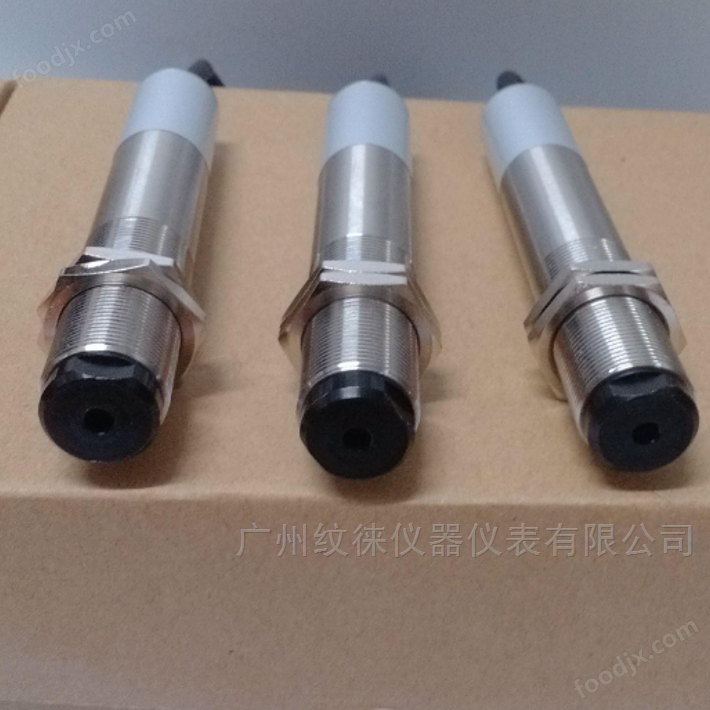


TG-05AW microwave infrared thermometer
NegotiableUpdate on 01/19
- Model
- Nature of the Manufacturer
- Producers
- Product Category
- Place of Origin
Overview
The LT-05TW microwave infrared thermometer has a wide range of applications and strong adaptability. Even in strong magnetic and microwave environments, it can work normally. The TG-05AW microwave infrared thermometer has a fast response of 0.5S, which is sufficient to handle it with ease.
Product Details
TG-05AW microwave infrared thermometer
Instructions:
Short and concise, very suitable for temperature measurement in small spaces such as distribution cabinets.
Widely applicable and adaptable. Even in strong magnetic and microwave environments, it can work normally. And it has a fast response time of 0.5S, which is sufficient to handle it with ease.
Technical Specifications:
Temperature measurement range: 0-500 ℃
Measurement accuracy: ± 1.5% or ± 1.5 ℃
Working power supply: 24VDC four wire system
Linear output: 4~20mA
Current: 50mA
Radiation rate: adjustable from 0.1 to 1.0
Sampling speed: 300mS
Working environment: 0-60 ℃, 10-95% RH
Lead length: Standard 2 meters (customizable length)
Short and concise, very suitable for temperature measurement in small spaces such as distribution cabinets.
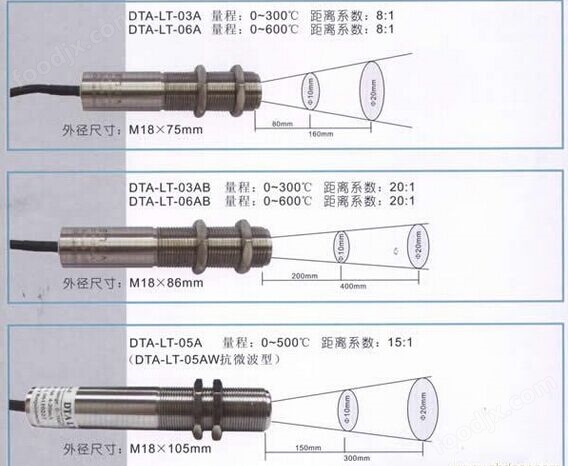
TG-05AW microwave infrared thermometer
LT-05TW Microwave Infrared ThermometerWidely applicable and adaptable. Even in strong magnetic and microwave environments, it can work normally. And it has a fast response time of 0.5S, which is sufficient to handle it with ease.
A thermal sensor utilizes the radiation heat effect to cause a temperature rise in the detection device after receiving radiation energy, thereby causing a change in the performance of one column of the sensor in relation to temperature. By detecting changes in one of the performance indicators, radiation can be detected.
Infrared radiation is a type of light that is invisible to the human eye, but in fact, like any other light, it is also an objective substance. Any object with a temperature above thermodynamic zero will emit infrared radiation towards its surroundings. Infrared is a type of light that is located outside of red light in visible light, hence it is called infrared. Its wavelength range is roughly within the spectral range of 0.75 to 100 μ m.
infrared radiation
The physical essence of infrared radiation is thermal radiation. The higher the temperature of an object, the more infrared radiation it emits, and the stronger the energy of infrared radiation. Research has found that the thermal effects of various monochromatic lights in the solar spectrum gradually increase from purple light to red light, and the large thermal effects occur within the frequency range of infrared radiation. Therefore, infrared radiation is also known as thermal radiation or heat rays.
Sensing principle
A thermal sensor utilizes the radiation heat effect to cause a temperature rise in the detection device after receiving radiation energy, thereby causing a change in the performance of one column of the sensor in relation to temperature. By detecting changes in one of the performance indicators, radiation can be detected. In most cases, radiation is detected through the Seebeck effect. When a device receives radiation, it causes a non electric physical change, which can also be measured by appropriately changing it into an electric quantity
Notes:
1. Power requirements: Attention should be paid to the voltage range and connection polarity of the power supply.
2. The lens should be kept clean, and any dirt or dust on the lens can be wiped off with alcohol or a soft sponge.
3. Due to the bright background light of the target being measured (especially direct sunlight or strong lights), it can affect the accuracy of the measurement. Use objects to block strong light from direct targets and eliminate background light interference.
Similar Product Recommend