-
E-mail
617041508@qq.com
-
Phone
18861253727
-
Address
Sanhekou Industrial Zone, Tianning District, Changzhou City
Product Categories
Changzhou Dachu Drying Equipment Co., Ltd


Cuprous chloride dryer
NegotiableUpdate on 01/06
- Model
- Nature of the Manufacturer
- Producers
- Product Category
- Place of Origin
Overview
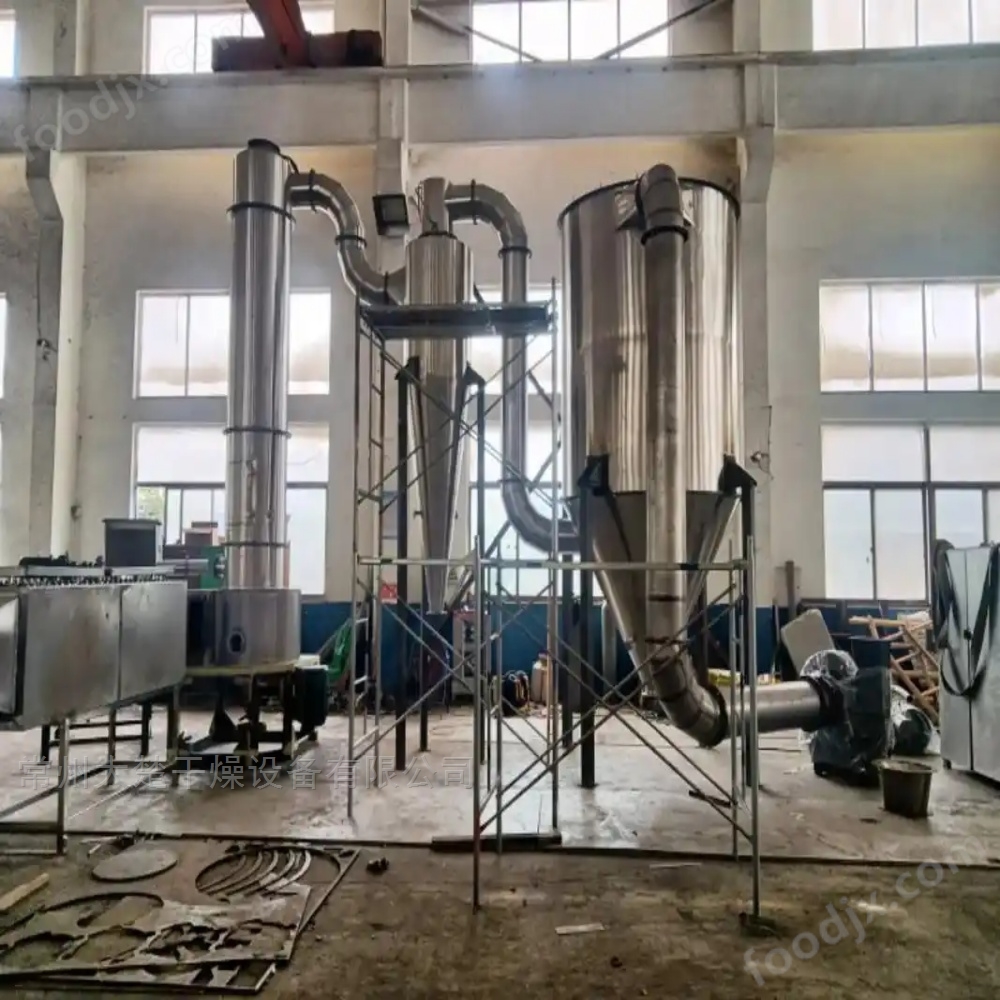
The cuprous chloride dryer is powered by hot air entering the bottom of the dryer through a tangent line, and creating a strong rotating wind field driven by a stirrer. The paste like material is fed into the dryer by a spiral feeder, and under the strong action of high-speed rotating stirring blades, the material is dispersed by impact, friction, and shear forces. The block like material is quickly crushed, fully contacted with hot air, heated, and dried. Widely used in the drying of high viscosity, high consistency, heat sensitive paste like materials in chemical industries such as light industry, petroleum, chemical fiber, food, mining, coatings, dyes, and intermediates.
Product Details
Working Principle:
Cuprous chloride dryer The material enters the dryer through a spiral feeder and is dispersed under the strong action of high-speed rotating stirring blades due to impact, friction, and shear forces. The block shaped material is quickly crushed, fully exposed to hot air, heated, and dried. The dehydrated dry material rises with the hot air flow, and the classification ring intercepts large particles. Small particles are discharged from the center of the ring outside the dryer and are recovered by the cyclone separator and dust collector. Undried or large materials are thrown towards the wall by centrifugal force and fall back to the bottom for crushing and drying.
Equipment features:
1. According to the characteristics of the material, a special cooling device is installed at the bottom of the dryer to avoid coking and deterioration of the material in the high-temperature zone at the bottom.
2. The circumferential air velocity in the drying chamber is high, and the material residence time is short, effectively preventing the material from sticking to the wall.
3. The drying chamber is equipped with grading rings and swirl blades, and the material fineness and final moisture can be adjusted and controlled.
4. Special pneumatic sealing device and bearing cooling device effectively extend the service life of the transmission part.
5. Drying, crushing, and screening can be completed within the equipment, which is simple, intelligent, efficient, and easy for employees to operate.
Application scope:
Cuprous chloride dryerIt is a new type of continuous drying equipment that integrates drying, crushing, and screening. It uses the impact and driving of high-speed airflow to quickly dry wet materials. Large and wet particle clusters can also be crushed and micronized under the circulating drying inside the equipment, and dried with high-speed airflow. Especially suitable for drying filter cake like, paste like, and slurry like materials. Not only can multiple feeding devices be flexibly selected and exchanged, but also air separation devices are used to reduce equipment resistance, effectively save energy, greatly reduce equipment construction consumption, and achieve high quality, high efficiency, low consumption, and cleanliness.
Applicable materials
Ceramics: kaolin, silica, clay;
Food category: soy protein, gelatinous starch, distiller's grains, wheat sugar, wheat starch, etc.
Dyes: anthraquinone, black iron oxide, indigo pigment, butyric acid, titanium hydroxide, zinc sulfide, various azo dye intermediates.
Organic compound: Atrazine (pesticide))Lauric acid, benzoic acid, benzoic acid, fungicide, sodium oxalate, cellulose acetate, etc;
Inorganic substances: boric acid, calcium carbonate, hydroxides, copper sulfate, iron oxide, barium carbonate, antimony trioxide, various metal hydroxides, various heavy metal salts, synthetic cryolite, etc.
Technical Specifications:
| Model Project | Cylinder diameter mm | Host size mm | Host power kw | Handling air volume | Evaporated water volume kg/h | Occupation area m2 |
| SXG-2 | 200 | 300×2800 | 0.75~2.2 | 300~800 | 10~20 | 3500×2500 |
| SXG-3 | 300 | 400×3300 | 3~4 | 600~1500 | 20~50 | 3800×2700 |
| SXG-4 | 400 | 500×3500 | 4~7.5 | 1250~2500 | 25~70 | 4000×3000 |
| SXG-5 | 500 | 600×4000 | 5.5~11 | 1500~4000 | 30~100 | 4200×3200 |
| SXG-6 | 600 | 700×4200 | 7.5~18.5 | 2500~5000 | 40~200 | 4250×3250 |
| SXG-8 | 800 | 900×4600 | 11~18.5 | 3000~8000 | 60~300 | 4500×3500 |
| SXG-10 | 1000 | 1100×5000 | 15~30 | 5000~12500 | 100~480 | 4750×3750 |
| SXG-12 | 1200 | 1300×5200 | 15~37 | 10000~20000 | 150~745 | 5000×4000 |
| SXG-14 | 1400 | 1500×5400 | 30~55 | 14000~27000 | 200~960 | 5250×4250 |
| SXG-16 | 1600 | 1700×6000 | 45~75 | 18700~36000 | 250~7303 | 5500×4500 |
Note: 1. The evaporation rate of water is calculated based on an inlet air temperature of 200 ℃ and an outlet air temperature of 80 ℃; 2. The installed capacity is the basic data and can be changed according to the physical and chemical properties of the material; 3. The land area is arranged according to the actual situation, and the data in the table is for reference only.
Processing materials and characteristics (based on Type 6 flash evaporation)
| Material Name | stearic acid | alumina | Zinc carbonate | monosultap | TMTD | DSD acid | iron oxide red | Antimony dioxide | Cuprous chloride | White too black |
| inlet air temperatureoC | 150 | 180 | 150 | 120 | 140 | 150 | 200 | 180 | 200 | 280 |
| Initial moisture content% | 80 | 55 | 80 | 30 | 65 | 60 | 60 | 45 | 30 | 85 |
| Final moisture content% | 0.5 | 1.5 | 1.0 | 1.0 | 0.5 | 0.5 | 0.5 | 1.0 | 3.0 | 5.0 |
| Actual drying capacity kg/h | 140-160 | 250-280 | 130-170 | 80-110 | 80-120 | 80-120 | 300-350 | 280-320 | 290-310 | 250-300 |
| Material Name | accelerator | Oil soluble ink | Manganese zinc substituted acid | Phthalic orchid | calcium citrate | Ultra fine calcium carbonate | Mud treatment agent | Sodium Dioxoisocyanurate | Sodium trimethoxyisocyanurate |
| inlet air temperatureoC | 150 | 150 | 120 | 150 | 140 | 160 | 200 | 180 | 150 |
| Initial moisture content% | 60 | 45 | 30 | 55 | 40 | 70 | 75 | 25 | 30 |
| Final moisture content% | 0.5 | 2.0 | 1.0 | 1.0 | 1.0 | 1.5 | 5.0 | 0.2-2 | 1.0 |
| Actual drying capacity kg/h | 80-110 | 350-380 | 120-150 | 160-180 | 300-350 | 430-470 | 290-310 | 80-120 | 90-150 |
Similar Product Recommend