-
E-mail
jwdry8166@163.com
-
Phone
13915898166
-
Address
Jiaoxi Industrial Park, Zhenglu Town, Tianning District, Changzhou City, Jiangsu Province
Changzhou Jinwang Drying Equipment Co., Ltd
Basic principles of food crushing equipment, technical analysis from mechanical force to fine processing
Date: 2025-07-27Read: 18
In the food industry, crushing is a key process for improving raw material utilization, enhancing product taste, and promoting nutrient release. Food crushing equipment crushes large pieces of material to the desired particle size through mechanical force, and its core principle involves multiple mechanical mechanisms such as shear, impact, extrusion, and grinding. Starting from the principles of fundamental mechanics, this article analyzes the operational logic and technical characteristics of different types of equipment.
1、 Shear force dominant: precise cutting of blade type crushing
Blade type crushing equipment (such as meat grinders and vegetable shredders) applies shear force to materials through high-speed rotating blades, achieving precise cutting. Its working principle can be divided into three stages:
1. Material feeding: The material enters the crushing chamber through the feeding port and comes into contact with the blade under the action of gravity or a screw propeller;
2. Shear crushing: The blade rotates at a speed of 500-3000r/min, causing relative motion between the blade and the material surface, resulting in shear stress perpendicular to the contact surface. When the stress exceeds the shear strength of the material, the cell wall or fiber bundle is cut off;
3. Particle size control: By adjusting the blade spacing (adjustable from 0.1-10mm) or installing screens with different mesh sizes, the particle size of the finished product can be controlled. For example, a certain brand of meat grinder adopts a double-layer blade design, which can crush meat into particles below 3mm, meeting the needs of meat filling processing.
2、 Impact driven: kinetic energy conversion of hammer crushing
Hammer crushers (such as grain mills) use high-speed rotating hammers to impact and crush materials, and their energy conversion process includes two key steps:
1. Acceleration stage: The hammer moves at a linear velocity of 1000-5000r/min, and the material is thrown towards the periphery of the crushing chamber under the action of centrifugal force;
2. Impact crushing: When the material collides with the toothed plate or sieve, kinetic energy is instantly released, generating stress waves that damage the internal structure of the material. The application data of a certain feed factory shows that the equipment can crush corn kernels to 40-60 mesh, with a cell wall fragmentation rate of over 85%, significantly improving starch digestion rate.
3、 Squeezing and Grinding Collaboration: Progressive Crushing of Roll Grinding
Roller press equipment (such as colloid mills and roller crushers) applies squeezing and grinding effects to materials through two relatively rotating roller bodies, suitable for high viscosity or easily clumped materials:
1. Pre extrusion stage: After the material enters the roller gap, it is subjected to a static pressure of 10-50 MPa, and the cell wall is initially ruptured;
2. Shear grinding: The surface of the roller is engraved with grooves or ridges, and the material is subjected to both shear and friction forces when passing through the roller gap, achieving nanoscale crushing. For example, a peanut butter production line uses a three roll colloid mill, which can grind peanut particles to below 2 μ m with a delicate texture and no graininess.
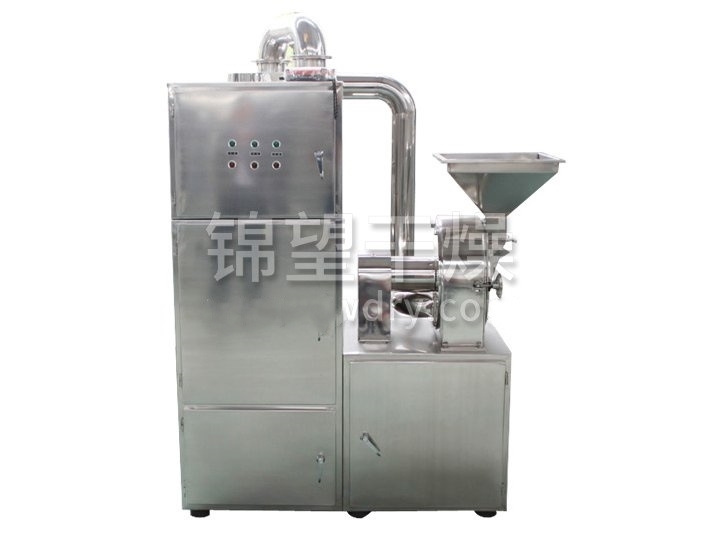
4、 Innovation in Composite Force Field: Technological Breakthrough in Low Temperature Ultra fine Grinding
For thermosensitive materials (such as traditional Chinese medicine and functional foods), a low-temperature ultrafine grinder combined with airflow impact and mechanical grinding can achieve cell level crushing at -20 ℃ to room temperature:
1. Liquid nitrogen pre cooling: The material is rapidly frozen by liquid nitrogen, which increases brittleness and reduces shear strength;
2. Airflow impact: Compressed air is ejected at supersonic speeds, carrying materials that collide with the target plate, resulting in microcracks;
3. Graded recycling: Collect 500-3000 mesh ultrafine powder through cyclone separator and bag filter. A certain Ganoderma spore powder processing enterprise adopted this technology, which increased the wall breaking rate from 60% to 98% and the polysaccharide dissolution rate by 40%.
From traditional blade cutting to low-temperature ultrafine grinding, the technological evolution of food crushing equipment has always revolved around the dual core of "efficiency improvement" and "quality assurance". With the integration of intelligent speed control, online granularity detection and other technologies, future equipment will achieve a leap from "extensive crushing" to "precise control", providing stronger support for the fine processing of the food industry.